





Most people who walk into my hospital asking about Sinus Surgery have already tried everything else. Steam inhalation twice a day. Three or four courses of antibiotics over the past year. Nasal sprays that sit half-used in a drawer. Saline rinses, ayurvedic remedies, a change of pillow covers, even a shift in diet. They arrive tired rather than dramatic, because chronic sinusitis rarely announces itself with one terrible day. Instead, it wears you down slowly a blocked nose that never fully clears, dull pressure behind the cheeks, thick discharge dripping down the back of the throat, and a sense of smell that faded so gradually you cannot name the month it disappeared.
At that stage, the honest question is no longer “which medicine next?” It becomes “why are the medicines not working?” And the answer, quite often, is mechanical rather than infectious which is exactly the situation Sinus Surgery was designed to correct.

Why Medicines Stop Working After a Point
Your sinuses are air-filled chambers inside the cheekbones, forehead, and behind the nose. Each one drains through a narrow channel, some barely a few millimetres wide. A thin carpet of moving hair-like cilia sweeps mucus through those channels all day, every day. As long as the drainage pathway stays open, the system cleans itself.
Chronic sinusitis develops when that pathway stays blocked for months. Swollen tissue, a deviated septum, enlarged turbinates, or nasal polyps narrow the exit. Mucus then pools inside the sinus, bacteria settle into that stagnant pocket, and inflammation thickens the lining further which narrows the opening even more. The cycle feeds itself.
Antibiotics can clear the bacteria sitting in that pocket. However, they cannot widen the blocked channel. Steroid sprays reduce swelling, yet they struggle to reach a sinus whose door is already shut. Therefore, patients improve for two weeks, then slide back. That repeating pattern better, worse, better, worse is usually the clearest sign that the problem has become structural.
When Surgery Genuinely Becomes the Right Answer
Surgery is not the first step, and no responsible surgeon treats it that way. Before recommending an operation, I want three things.
First, a proper trial of medical treatment. That means the right medication, at the right dose, for the right duration usually eight to twelve weeks of a structured plan, not scattered courses.
Second, a nasal endoscopy. A thin 4 mm scope passes into the nose and shows the drainage areas directly. Pus tracking from a specific sinus, polyps sitting in the middle meatus, or a septum pressing against the side wall all become visible in seconds.
Third, a CT scan of the paranasal sinuses. The scan maps which sinuses are diseased, how thick the lining has become, and where the anatomy is unusual. Consequently, the surgery becomes planned rather than exploration.
If all three point the same way persistent symptoms, visible blockage, and confirmed disease on imaging then surgery stops being an aggressive option and starts being the logical one. Patients travelling from across the region for a consultation with the Best Sinus Doctor in Punjab usually reach this point after a year or more of frustration, and the relief on hearing a clear explanation is often as valuable as the treatment itself. A Sinus Surgeon Ropar patient can reach easily matters too, because follow-up cleaning visits are part of the process. For anyone searching for Sinus Treatment Ropar near Chandigarh or comparing options with the Best Sinus Doctor Near Chandigarh, the deciding factor should be diagnostic thoroughness rather than distance alone.
What Modern Sinus Surgery Actually Involves
The phrase “sinus operation” still makes people imagine external cuts, facial swelling, and a week in hospital. That version of the procedure belongs to a previous generation.
Today the standard approach is Functional Endoscopic Sinus Surgery (FESS). Everything happens through the nostrils. No incision on the face, no stitches on the skin, no bruise around the eyes. A high-definition endoscope provides magnified vision of the deepest recesses, while fine instruments and a microdebrider remove diseased tissue and polyps with millimetre precision.
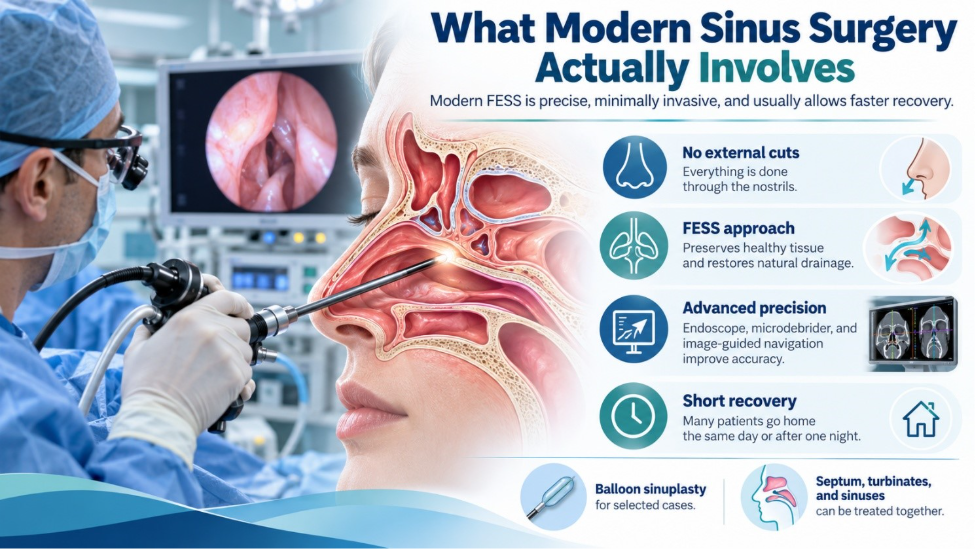
The word “functional” carries real meaning here. The goal is not to scoop out the sinuses. Instead, the surgeon opens the natural drainage pathways and preserves the healthy lining, so the cilia can resume their normal sweeping action. In other words, the operation restores the system rather than replacing it.
Several refinements have changed outcomes considerably:
- Image-guided navigation links the CT scan to the instrument tip in real time, which adds a safety margin near the eye socket and skull base.
- Combined procedures address the whole picture in one sitting. A deviated septum gets straightened, enlarged turbinates get reduced, and the sinuses get opened together, because fixing one and ignoring the others invites relapse.
- Absorbable dressings have largely replaced the old ribbon gauze packing that patients dreaded. Removal discomfort has dropped dramatically as a result.
Most cases take one to two hours under general anaesthesia. Many patients go home the same day or after a single night.
Recovery: An Honest Timeline
Expectations matter more than promises, so here is the realistic version.
Days 1–3: The nose feels blocked, like a heavy cold. Mild blood-tinged discharge is normal. Sleeping with the head slightly raised helps.
Week 1: Congestion peaks around day three, then eases. Saline irrigation becomes your most important daily habit. Avoid nose-blowing, heavy lifting, and gym workouts.
Weeks 2–4: Breathing improves noticeably. Crusts form as the lining heals, and your surgeon clears them during endoscopic cleaning visits. These visits genuinely influence the outcome, so skipping them is a mistake.
Months 2–3: Smell returns gradually for most polyp patients. Facial pressure settles. Sleep quality improves, and partners frequently report less snoring.
Full mucosal healing takes about three months. Meanwhile, most people return to desk work within five to seven days.
What Surgery Fixes and What It Does Not
Surgery reliably restores drainage and airflow. Studies consistently show significant symptom improvement in a large majority of properly selected patients, and quality-of-life scores climb sharply.
Still, surgery does not cure allergies. It does not switch off asthma. It does not guarantee that polyps will never return, particularly in allergic or aspirin-sensitive patients. Because of this, the operation should be viewed as a reset rather than a full stop. Continued nasal sprays, allergy control, and periodic review keep the result durable. Patients who follow that plan rarely need a second procedure; those who stop everything the moment they feel better are the ones who come back.
Risks exist, of course, though serious complications remain uncommon in experienced hands. Minor bleeding, temporary numbness of the front teeth, and scar adhesions top the list. Careful techniques, navigation where needed, and disciplined follow-up to these numbers low.
Taking the Next Step
If you have spent more than three months battling a blocked nose, facial heaviness, post-nasal drip, or a fading sense of smell, you deserve a real diagnosis rather than another prescription. A twenty-minute consultation with endoscopy usually answers more than a year of guesswork.
The team at Dr. Ram ENT Hospital in Ropar evaluates every sinus patient with endoscopy and imaging before discussing any surgical option, because the right decision depends entirely on what the anatomy shows. Led by Dr. Ram Kumar, an ENT surgeon trained at PGIMER Chandigarh with over thirteen years of experience in endoscopic nasal surgery, Dr. Ram ENT Hospital offers advanced sinus care close to home for families across Rupnagar, Chandigarh, Mohali, and the surrounding districts. Breathing freely again is a reasonable expectation and usually a very achievable one.
Frequently Asked Questions
1. Why do I need a CT scan when endoscopy already shows blockage?
Endoscopy shows the surface; CT shows the depth. The scan reveals which sinuses are involved, how thick the mucosal lining has become, and whether anatomical variants sit near the eye socket or skull base. Surgeons also use the scan for intraoperative navigation. Without it, the operation would proceed with incomplete information.
2. Will my sense of smell definitely return after surgery?
Smelling loss caused by mechanical blockage polyps or swelling physically covering the olfactory area usually improves substantially within weeks. However, when inflammation has damaged the olfactory nerve endings over many years, recovery becomes partial and slower. Earlier treatment therefore gives better odds.
3. Can nasal polyps grow back after removal?
Yes, particularly in patients with allergic rhinitis, asthma, or aspirin sensitivity. Polyps reflect an underlying inflammatory tendency, and surgery removes the growth rather than the tendency. Consistent post-operative steroid sprays, saline rinses, and allergy management reduce recurrence considerably, which is why long-term follow-up forms part of the treatment plan.
4. Is chronic sinusitis surgery safe for diabetic or elderly patients?
Generally, yes, provided the medical condition is stable and well controlled before the date. Diabetic patients need good sugar control because healing and infection risk depend on it. Anaesthetic fitness assessment, medication review, and sometimes a shorter, more targeted procedure make surgery a practical option well into later decades of life.