




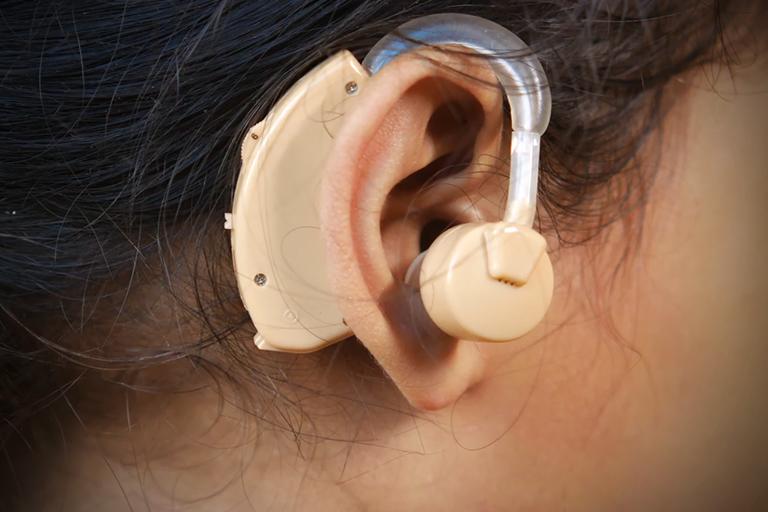
Severe hearing loss does not just affect how well a person hears it changes how they connect with their family, how children learn to speak, and how adults participate in everyday life. For many patients who walk through our doors at Dr. Ram ENT Hospital in Ropar, hearing aids have already been tried. Some have spent months or years adjusting to amplified sound, only to find that clarity and understanding remain frustratingly out of reach. That is precisely where cochlear implant surgery becomes a life-changing option.
As an ENT specialist with extensive experience in cochlear implantation and hearing rehabilitation, I want to walk you through everything that matters what this device does, who the right candidates are, what the surgery involves, and what kind of results patients genuinely achieve.
What Is a Cochlear Implant and How Is It Different from a Hearing Aid?
This is the first question most families ask. A hearing aid amplifies sound so that damaged hair cells inside the ear can still process it. When those hair cells are severely damaged or absent, amplification alone is not enough there is nothing functioning inside the cochlea to respond to the louder sound.
A cochlear implant takes a completely different approach. It bypasses the damaged inner ear entirely and sends electrical signals directly to the auditory nerve. The device has two parts: an internal component surgically placed inside the cochlea, and an external sound processor worn behind the ear. Together, they capture sound from the environment, convert it into electrical impulses, and deliver those impulses straight to the nerve which then carries them to the brain for interpretation.
The result is not amplified sound. It is a new pathway for sound one that does not depend on the damaged structures that hearing aids cannot fix.
Who Actually Needs a Cochlear Implant?
Not every patient with hearing loss requires a cochlear implant. Based on clinical guidelines and years of evaluating patients from Ropar and across Punjab, implantation is typically recommended for the following groups:
- Adults with severe to profound sensorineural hearing loss who score poorly on speech recognition tests even while wearing hearing aids.
- Children born with bilateral profound hearing loss, especially those identified early through newborn hearing screening.
- Individuals with progressive hearing loss who have reached the point where aided hearing no longer supports meaningful communication.
- Patients with post-meningitis or post-viral deafness, where sudden damage to the inner ear has caused rapid decline.
- Adults who have lost hearing later in life due to aging, trauma, or ototoxic medications and find that hearing aids no longer provide adequate benefit.
The key determining factor is not simply the degree of hearing loss on an audiogram it is how much functional benefit the patient is getting from amplification. A detailed evaluation at our centre includes Pure Tone Audiometry, speech recognition testing in quiet and noisy conditions, CT and MRI scans of the inner ear, and a structured hearing aid trial. This comprehensive workup ensures that every implant recommendation is clinically justified.
Early Implantation in Children: Why Timing Matters More Than Most Parents Realise
For children, the first few years of life represent a critical window for language acquisition. The brain is highly adaptable during this period, and auditory stimulation during early childhood directly shapes how speech and language develop. Children who receive cochlear implants before the age of two particularly those with confirmed bilateral profound hearing loss consistently show better long-term outcomes in speech development, vocabulary growth, and academic performance compared to those implanted later.
At Dr. Ram ENT Hospital, we work with families to identify hearing loss as early as possible and guide them through the candidacy process without unnecessary delay. Early identification, early assessment, and early treatment this is the pathway that gives children born with severe hearing loss the best possible start.
What Does Cochlear Implant Surgery Involve?
The surgery itself is performed under general anaesthesia and typically takes two to four hours. A small incision is made behind the ear to access the mastoid bone. The surgeon then carefully creates a channel to reach the cochlea and inserts the electrode array into the inner ear. The internal receiver-stimulator is secured in a small well created in the bone behind the ear.
Patients are usually discharged within one to two days. The surgical site heals over two to four weeks, after which the external sound processor is fitted and activated. This activation appointment sometimes called switch-on is a memorable moment for most families. The programming and fine-tuning of the device continues over multiple follow-up visits, as the audiologist adjusts the processor settings to match each individual’s hearing profile.
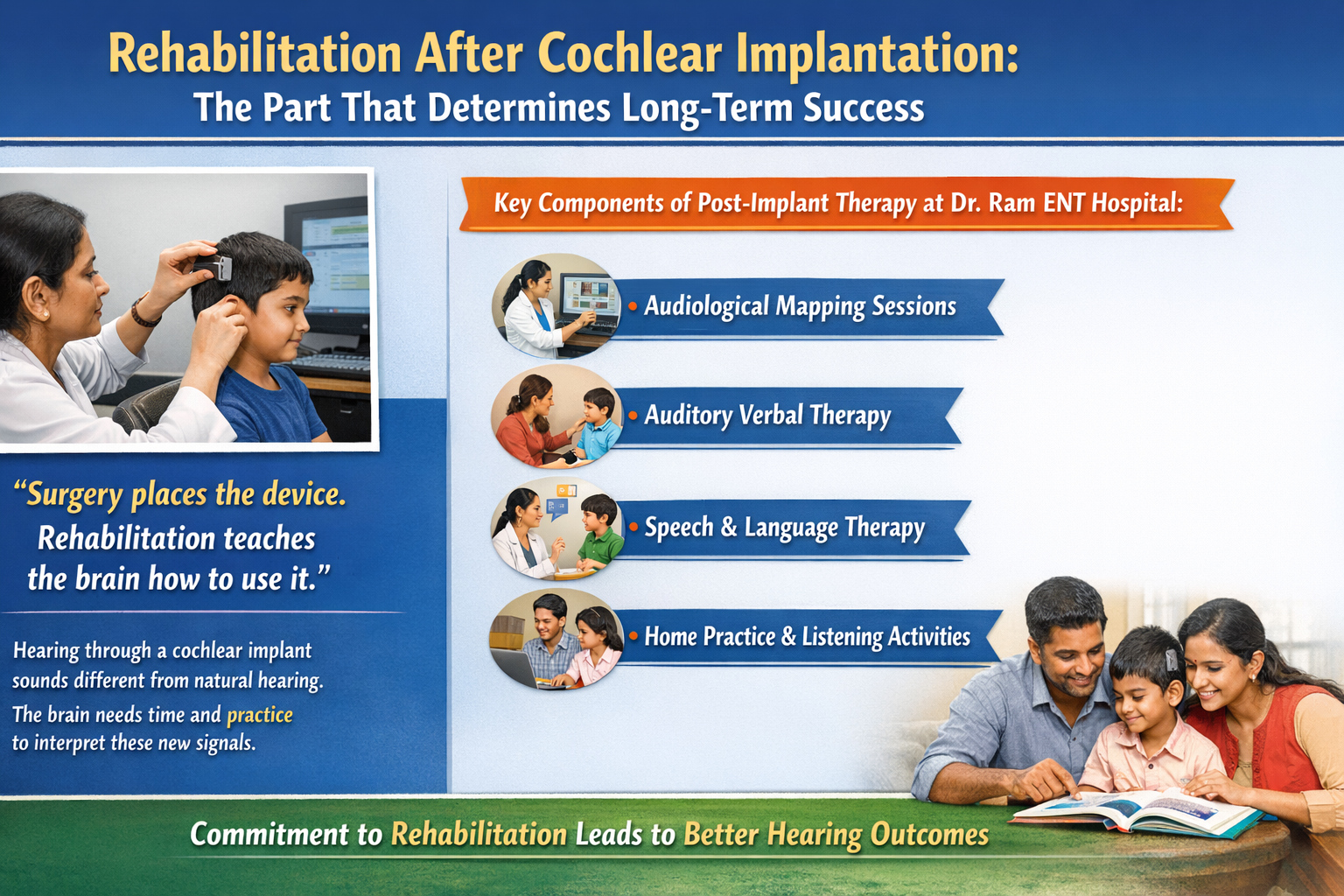
Rehabilitation After Cochlear Implantation: The Part That Determines Long-Term Success
Surgery places the device. Rehabilitation teaches the brain how to use it. This is a distinction that many patients do not fully appreciate before their procedure. Hearing through a cochlear implant sounds different from natural hearing, especially in the early weeks. The brain needs time and structured practice to learn how to interpret these new electrical signals as meaningful sound.
A structured post-surgery rehabilitation plan at Dr. Ram ENT Hospital typically includes:
- Regular audiological mapping sessions to fine-tune the device as hearing develops.
- Auditory verbal therapy to help patients connect electrical sounds to meaningful speech.
- Speech therapy, particularly important for children developing language for the first time.
- Home practice exercises and listening activities to reinforce progress between clinic visits.
The commitment to rehabilitation from both the patient and their family plays a direct role in outcomes. Patients who engage consistently with post-implant therapy progress faster and ultimately achieve better hearing than those who treat the surgery as the end point.
What Results Can You Realistically Expect?
This is the question that matters most to patients and their families. Results from cochlear implantation are strong but they are not uniform, and setting realistic expectations before surgery is part of responsible care.
Most implant recipients experience significant improvements in:
- Speech understanding particularly in quiet environments, and progressively in background noise with practice.
- Ability to follow conversations without relying entirely on lip reading.
- Awareness of environmental sounds such as traffic, alarms, and voices in other rooms.
- Quality of life, social confidence, and independence in daily activities.
Children implanted early frequently develop speech and language that falls within the normal range for their age. Adults who lost hearing after already developing language tend to adapt more quickly than those who have been deaf from birth. In both groups, consistent use of the device and active participation in rehabilitation are the strongest predictors of a successful outcome.
Why Patients from Ropar Choose Dr. Ram ENT Hospital
At Dr. Ram ENT Hospital, cochlear implant services are not a peripheral offering they are a core part of what we do. Our approach combines advanced diagnostic equipment, surgical expertise developed through formal training at PGIMER Chandigarh, and a structured rehabilitation pathway that continues well beyond the operation itself.
Patients from Ropar and the wider Punjab region come to us because they want a centre where the entire journey from initial evaluation to long-term follow-up is managed by a team that understands hearing loss at both a clinical and a human level. We take the time to explain every step, involve families in the decision-making process, and ensure that no patient feels rushed toward a procedure they are not ready for.
If your child has not responded to hearing aids, or if your own hearing has deteriorated to the point where communication has become exhausting, the right next step is a proper specialist evaluation. Contact Dr. Ram ENT Hospital today to schedule a comprehensive hearing assessment and find out whether cochlear implant surgery is the right option for you or your loved one.
Frequently Asked Questions
1. My child uses hearing aids but still struggles with speech. How do I know if a cochlear implant evaluation is warranted?
The most reliable indicator is speech recognition performance in a controlled listening environment. If your child scores below 50% on open-set sentence recognition tests while wearing well-fitted hearing aids, a formal cochlear implant candidacy evaluation is appropriate. Poor speech and language development relative to peers despite consistent hearing aid use and therapy is another strong signal. A thorough audiological and ENT assessment will give you a clear answer based on clinical data rather than guesswork.
2. Does cochlear implantation permanently damage any remaining natural hearing?
In most patients with severe to profound hearing loss, the residual natural hearing before implantation is already too limited to be functionally useful. The surgical procedure does typically affect whatever residual low-frequency hearing exists in the implanted ear. Hearing-preservation surgical techniques have improved significantly, and in carefully selected cases, some residual hearing can be maintained. This is something your surgeon will assess and discuss with you individually before surgery, since the appropriate approach depends on the patient’s specific audiological profile.
3. How long does the rehabilitation process take before a patient can hold a normal conversation?
This varies considerably between patients. Adults who lost hearing later in life and therefore have established auditory memory often achieve functional speech understanding within three to six months of activation. Post-lingually deafened adults frequently progress faster than pre-lingually deafened individuals. For children implanted early, the process of building language takes longer by nature, though most show significant developmental gains within the first year. Full benefit from the implant often continues to develop over two to three years with consistent therapy and device use.
4. Are there any medical conditions that would prevent someone from being a cochlear implant candidate?
Certain anatomical factors such as an absent or severely malformed cochlea, or an absent auditory nerve may limit or rule out conventional cochlear implantation. Active middle ear infections need treatment before surgery proceeds. Medical conditions that increase anaesthetic risk are assessed during the pre-operative workup. CT and MRI imaging of the inner ear is a standard part of the candidacy process precisely to identify any structural factors that would influence surgical planning or device selection. Most patients with appropriate hearing loss criteria and no disqualifying anatomy do proceed to surgery successfully.
5. Will a cochlear implant need to be replaced or upgraded over time?
The internal implant is designed to last for decades and rarely requires replacement under normal circumstances. The external sound processor, however, does undergo periodic upgrades typically every four to six years as technology improves. Most implant manufacturers maintain backward compatibility, meaning a newer processor can work with an older internal device. Upgrading the external processor does not require additional surgery and can meaningfully improve hearing performance as processing technology advances. This long-term upgrade pathway is one reason cochlear implantation represents a durable investment in hearing rather than a one-time solution.