




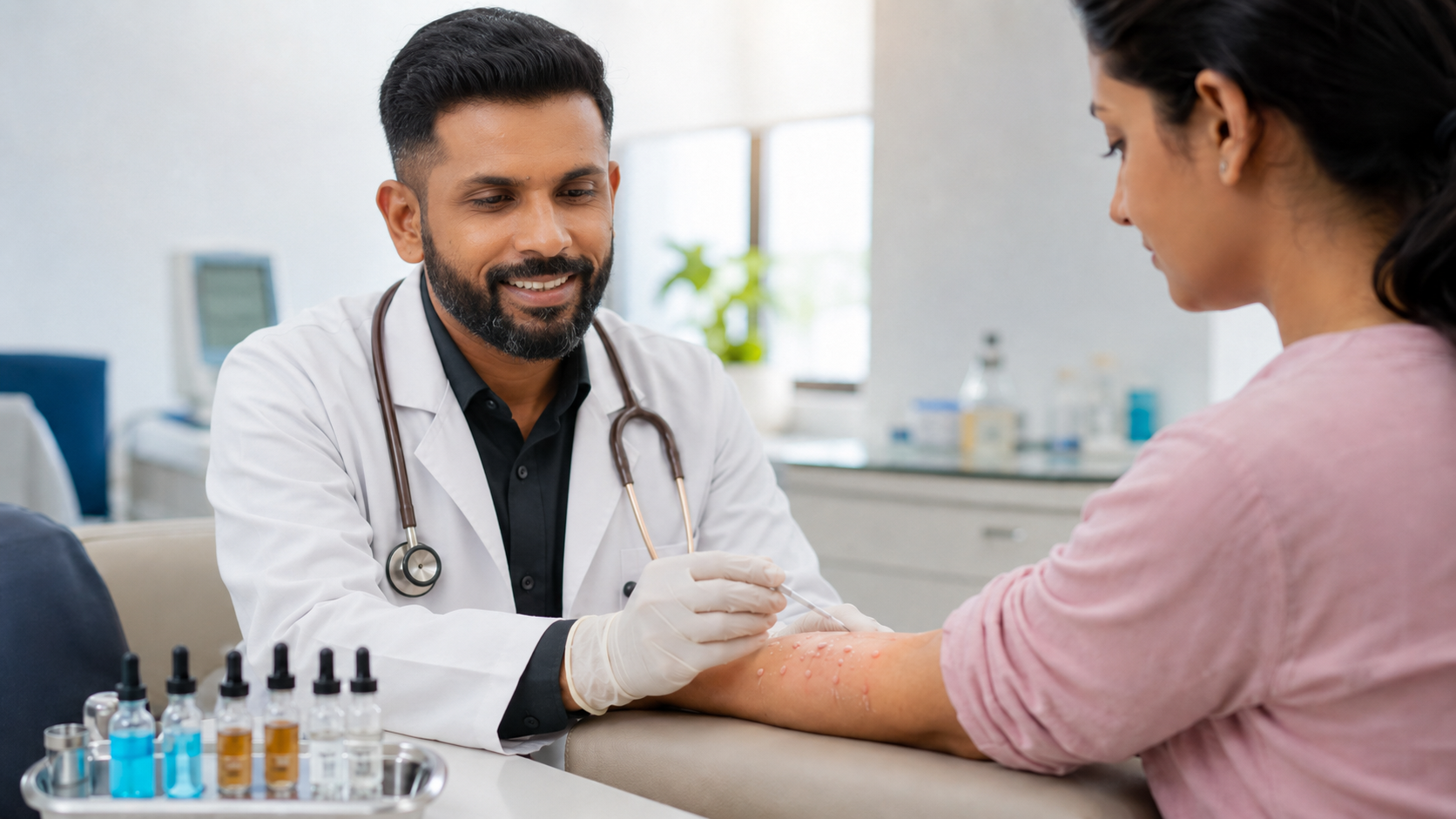
At Dr. Ram ENT Hospital in Ropar, Punjab, skin prick testing may be performed as part of an allergy evaluation when clinically appropriate. Before the procedure, patients often ask an important question: how accurate is a skin prick test? This question is also common among families searching for a skin prick test in Ropar near Chandigarh. Because the test results can shape treatment, everyday exposure choices, and long-term symptom control, it helps to understand exactly what the test measures, how it is performed, and how the results should be interpreted.
Skin prick testing is one of the most widely used tools for identifying allergic sensitisation. Its value depends not only on the skin reaction itself but also on careful preparation, correct technique, reliable controls, and interpretation alongside your symptoms and medical history. When those pieces come together, the results become far more useful and far less likely to point you in the wrong direction.
| Key Takeaways • A skin prick test checks whether your immune system is sensitised to specific allergens, with results in about 15–20 minutes. • It is excellent at ruling allergies out a clean result is highly reliable (negative predictive value often above 90%). • A positive result shows sensitisation, not proof of allergy; it only matters when it matches your symptoms. • Medicines (especially antihistamines), skin condition, age, and extract quality can all change the result. • Results mean the most when an experienced ENT or allergy specialist reads them alongside your history. |
What Is a Skin Prick Test?
A skin prick test is a commonly used allergy test that checks whether the immune system is sensitised to specific substances such as dust mites, pollens, moulds, animal dander, or selected foods. It works by exposing the surface of the skin to very small amounts of allergen extracts and observing whether a local reaction develops. For patients considering allergy testing in Ropar, Punjab, it offers a quick way to assess multiple possible triggers during a single appointment.
How Is It Performed?
During the procedure, a clinician places tiny droplets of purified allergen extracts on your forearm or back and gently pricks the skin through each droplet with a sterile lancet. The lancet only breaks the surface lightly, so most people describe the sensation as a small scratch rather than pain. Several allergens can be checked in one sitting.
If your body carries IgE antibodies against a particular allergen, mast cells in the skin release histamine within minutes. A raised, itchy bump called a wheal appears, surrounded by redness. After about 15 to 20 minutes, the clinician measures each wheal in millimetres and compares it against a positive and a negative control. Generally, a wheal 3 mm or more larger than the negative control counts as a positive response.
A wheal shows that your immune system recognises a particular allergen, but it does not automatically prove that allergen is responsible for your symptoms. Specialists distinguish between sensitisation and clinical allergy, which is why test findings are always interpreted together with your history and symptom pattern.
The Real Accuracy Numbers
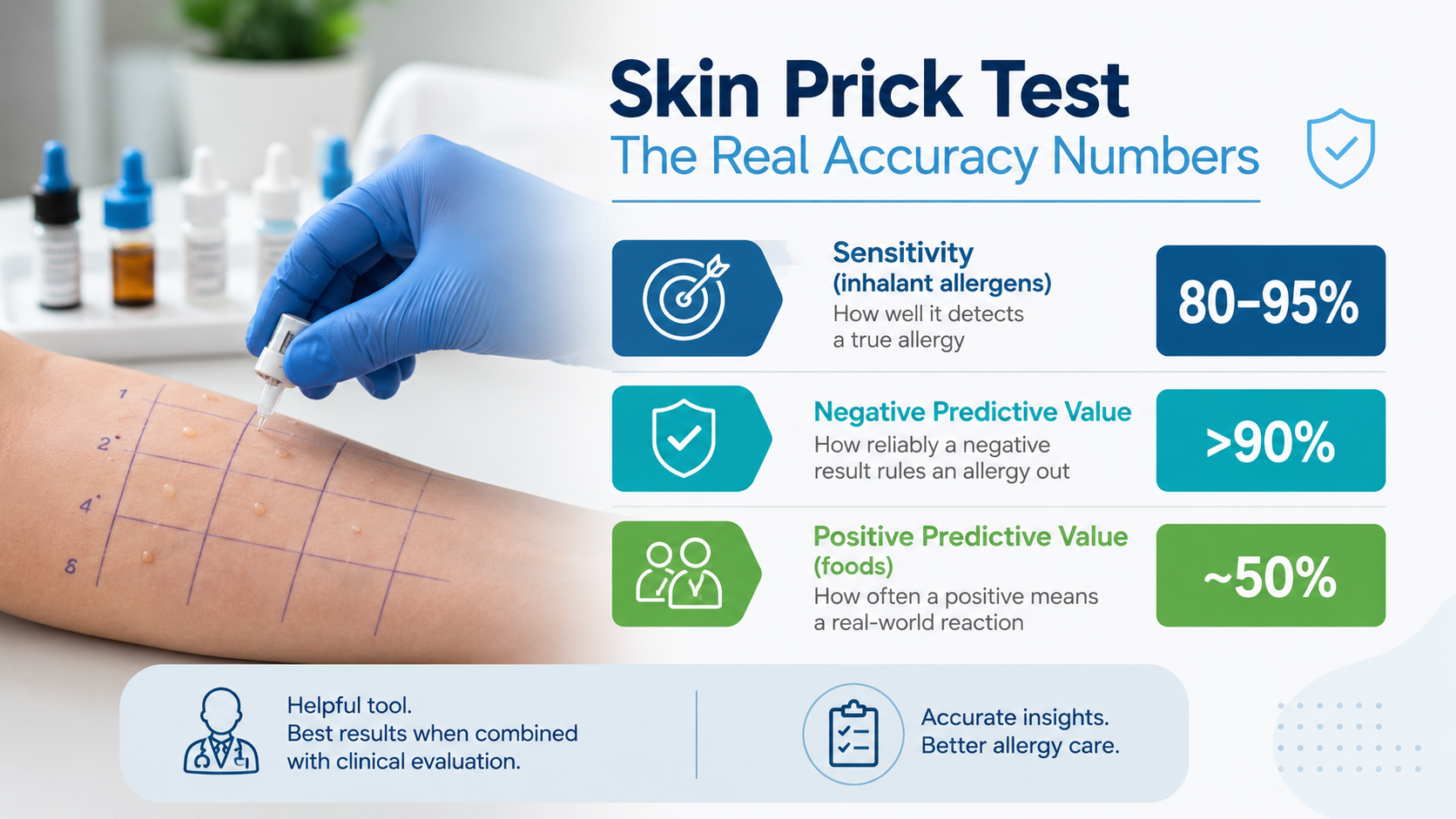
Clinically, skin prick testing shows high sensitivity for inhaled allergens such as dust mite, pollen, moulds, and animal dander. In practice, sensitivity commonly lands somewhere between 80 and 95 percent, depending on the allergen and the extract used. Specificity, however, runs lower particularly for foods.
| Measure | What it tells you | Typical range |
| Sensitivity (inhalant allergens) | How well it detects a true allergy | 80–95% |
| Negative predictive value | How reliably a negative result rules an allergy out | >90% |
| Positive predictive value (foods) | How often a positive means a real-world reaction | ~50% |
In plain language:
A negative result is highly informative. When the test comes back clean for an allergen and the histamine control has worked properly, the chance that you are truly allergic to it drops sharply. Negative predictive value often exceeds 90 percent, which is why ruling things out is where this test genuinely shines.
A positive result needs context. Positive predictive value for food allergens sits closer to 50 percent in many studies. In other words, roughly half of positive food reactions on skin never cause a real-world problem when that food is actually eaten. Inhalant allergens perform better, though the same principle applies.
This is why an experienced ENT or allergy specialist interprets skin prick test results together with your symptom diary, seasonal pattern, home environment, occupational exposure, and family history. A dust-mite reaction carries far more clinical meaning when it matches symptoms such as morning nasal blockage or sneezing. At an allergy clinic in Ropar near Chandigarh, this clinical context is what separates a relevant trigger from sensitisation that may not be causing any symptoms at all.
Factors That Can Change Your Results
An allergy test on skin is a biological measurement, not a machine reading. Several variables can shift the outcome, and most of them are controllable once you know about them in advance. Anyone booking a skin prick test in Punjab should read the next few points before the appointment.
1. Medicines Already in Your System
This causes more false negatives than anything else. Antihistamines block the very reaction the test depends on, so both prescription and over-the-counter tablets must be stopped before testing. Most specialists ask for a gap of five to seven days, and longer for certain long-acting molecules. Cough syrups, cold combinations, and sleep aids frequently contain hidden antihistamines, which patients rarely think to mention.
In addition, tricyclic antidepressants such as amitriptyline suppress skin reactivity strongly and may need up to two weeks of clearance under medical supervision. Some anti-nausea medicines and older heartburn drugs interfere as well, and biologic therapy such as omalizumab can blunt responses for months.
Several medicines, on the other hand, cause no problem at all. Inhalers, montelukast, and nasal steroid sprays do not need to be stopped. Never discontinue asthma or cardiac medication on your own before an allergy test always confirm with the treating doctor first.
2. The Condition of Your Skin
The test needs healthy, unbroken, untreated skin. Active eczema, psoriasis patches, sunburn, or heavy tattooing over the testing area force the clinician to choose a different site. Similarly, potent topical steroid creams applied to the forearm or back for a week or two beforehand can suppress local reactivity.
Dermographism creates the opposite problem. Some people develop raised welts from any mechanical scratch, which produces false positives across the board. Fortunately, the negative saline control catches this immediately, and the clinician can then switch to blood testing instead.
3. Your Age
Skin reactivity is not constant throughout life. Infants and very young children generally produce smaller wheals, so specialists interpret their results using appropriate age thresholds. Reactivity peaks in young adulthood and then gradually declines. As a result, a patient in their seventies may show only a modest response to an allergen that genuinely troubles them, and the clinician accounts for that during interpretation.
4. Extract Quality and Storage
This factor stays invisible to patients, yet it matters enormously. Allergen extracts lose potency when stored incorrectly or used past expiry, and unstandardised extracts vary between manufacturers. During a Punjab summer, a clinic without disciplined cold-chain practice can quietly degrade its entire panel. Reputable centres maintain refrigeration logs and rotate stock accordingly something worth asking about before booking a skin allergy test in Punjab.
5. Technique and Timing
Two lancets placed too close together allow overlapping wheals, which inflates readings. Too much pressure causes bleeding and false positives; too little fails to deliver the allergen at all. Reading the panel at ten minutes underestimates responses, while reading at forty minutes lets wheals fade. Ultimately, operator training influences accuracy as much as the extracts themselves.
6. Recent Severe Reactions and Illness
After a major anaphylactic episode, mast cells enter a temporary refractory state and may not respond normally for four to six weeks. Testing during that window risks a misleading negative. Likewise, an active fever or a recent course of high-dose oral steroids can dampen the response.
The Controls That Keep the Test Honest
Every properly performed panel includes two reference points, and you should look for both in your report.
Positive control (histamine). It must produce a clear wheal. If it does not, something is suppressing your skin usually a medicine and every negative result on that panel becomes unreliable.
Negative control (saline or glycerine). It should produce nothing. Any reaction here signals dermographism, which means all the positives need reinterpretation.
Properly documented controls are essential when interpreting allergy testing. If the histamine and negative controls are not recorded, or do not behave as expected, the rest of the skin prick test may be difficult to interpret reliably.
How to Prepare So Your Results Mean Something
Preparation determines quality. Before your appointment, follow these steps:
- List every medicine, syrup, and supplement you take, including anything bought without a prescription.
- Stop antihistamines exactly as instructed not a day earlier or later.
- Avoid applying moisturiser, oil, or steroid cream to the forearms and back on the day of testing.
- Wear a loose half-sleeve top for easy access.
- Keep a two-week symptom diary noting time of day, location, weather, and activity.
That last point deserves emphasis. In Ropar, Punjab, symptom patterns can offer valuable clues about likely triggers. Symptoms that worsen during paddy stubble season, humid monsoon weeks, or time spent in an air-conditioned bedroom may each point to different exposures. For patients undergoing allergy testing in Ropar near Chandigarh, a simple symptom diary can make the skin prick test results much easier to interpret in context.
Reading Your Report Sensibly
Bigger wheals suggest stronger sensitisation, but size does not predict how severe a reaction will be. A 4 mm peanut wheal can accompany a dangerous allergy, while a 12 mm dust-mite wheal may cause nothing worse than morning sneezing. Never rank risk by millimetres alone.
A positive result also carries meaning only when the allergen actually exists in your environment. Sensitisation to birch pollen matters little for someone living in Rupnagar, where that tree simply is not part of the local flora.
When results and symptoms disagree, specialists add further steps. Specific IgE blood testing helps when medicines cannot be stopped or when skin disease blocks testing. Component-resolved diagnostics distinguish genuine food allergy from pollen cross-reactivity. For food questions, a supervised oral food challenge remains the definitive answer. For nasal complaints, nasal endoscopy identifies structural contributors that no allergy test on skin will ever reveal.
The Bottom Line
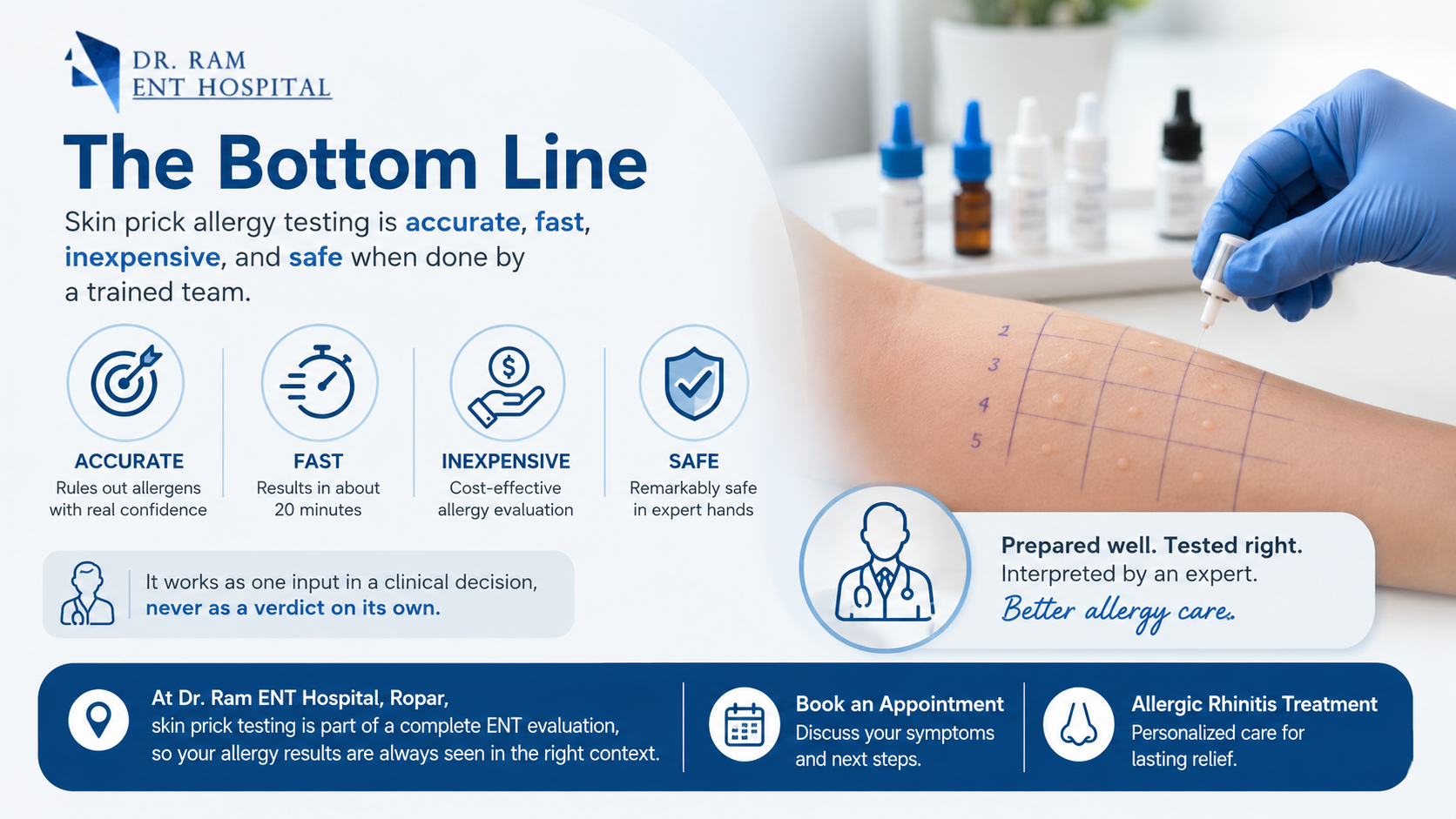
Skin prick allergy testing is accurate, fast, inexpensive, and remarkably safe when a trained team performs and interprets it. It rules out allergens with real confidence and identifies likely triggers within about twenty minutes. Even so, it works as one input in a clinical decision, never as a verdict on its own. Preparation, technique, controls, and interpretation together decide whether your report guides treatment or misleads it. Ideally, an experienced ENT specialist in Ropar, Punjab reads the panel beside your history never in isolation.
At Dr. Ram ENT Hospital in Ropar, Punjab, skin prick testing can be considered alongside a full ENT evaluation, so that allergy findings are interpreted together with your nasal and respiratory symptoms. If you are looking for a skin prick test in Ropar near Chandigarh, you can discuss your symptom history, possible triggers, and the most appropriate next step with our clinical team. Book an appointment or learn more about our allergic rhinitis treatment.
Frequently Asked Questions
Q1. My skin prick test was negative, but my symptoms continue every morning. What explains this?
Two possibilities deserve investigation. First, local allergic rhinitis produces IgE within the nasal lining alone, so skin and blood tests stay negative while the nose still reacts. Second, your symptoms may stem from non-allergic rhinitis triggered by temperature shifts, pollution, strong odours, or a deviated septum. Nasal endoscopy usually clarifies which pathway applies, and the treatment differs considerably between them.
Q2. Can I take my nasal steroid spray before testing, or does it need to stop like antihistamines?
Intranasal corticosteroids do not need to stop. They act locally in the nose and do not meaningfully suppress skin mast cell responses. The same applies to asthma inhalers and montelukast. Only medicines with antihistaminic activity including many sedating cough syrups and certain antidepressants require a washout period before your appointment.
Q3. Why did the doctor recommend a blood test even after positive skin results?
Specific IgE testing measures antibody concentration numerically, which adds precision that wheal size cannot provide. For suspected food allergies, component testing separates stable proteins linked to genuine systemic reactions from cross-reactive pollen proteins that cause only mild oral itching. Combining both methods reduces unnecessary dietary restriction, particularly in children.
Q4. How long do positive results stay valid before retesting is needed?
Sensitisation patterns shift over years, not months. Children frequently outgrow milk and egg allergies, while new environmental sensitivities can develop after relocation or a change in occupation. Retesting every three to five years suits most adults, though earlier reassessment makes sense if symptoms change character, worsen despite treatment, or before planning immunotherapy.
Q5. Is skin prick testing safe for children and during pregnancy?
Children tolerate the procedure well, and specialists perform it from infancy onward using age-adjusted interpretation. Systemic reactions remain extremely rare. During pregnancy, most clinicians postpone skin testing and use specific IgE blood testing instead, since even a small anaphylaxis risk carries added consequences. Discuss timing with your doctor rather than deferring evaluation entirely.